The owner file
Responsible dog ownership in the South
Tags, fences, bite prevention and the neighbor file: what the code asks, what the street expects, and the distance between the two.
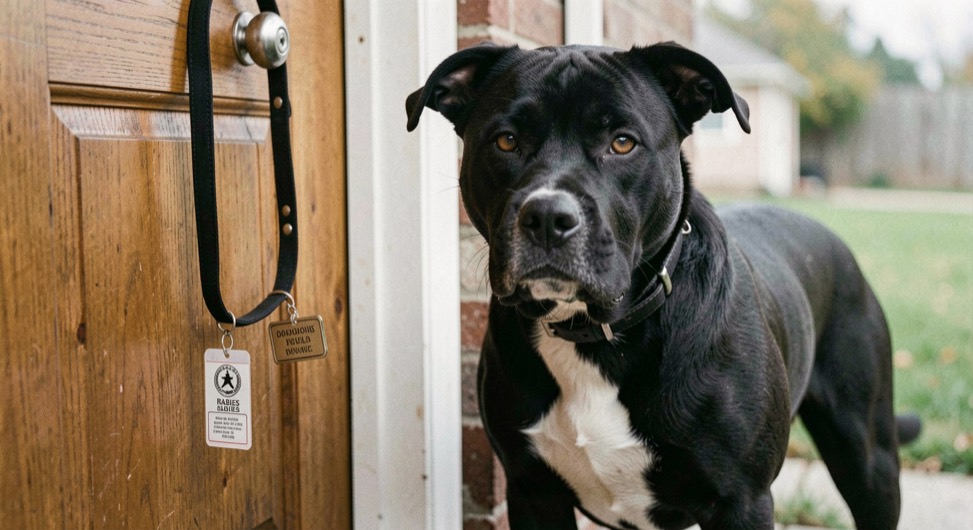
Responsible ownership in the South is a file, not a sentiment. The code asks for a collar and a tag, the city asks for containment and quiet, and the neighbor asks for all of it at once. An owner who holds the file answers every question from a drawer: the tag on the neck, the certificate in the folder, the fence in the photographs, the ordinance read once a year. This page builds that file, item by item, from the sections up.
The two halves of the subject are already on this site: the state's asks are read section by section at section 41-53-11 and its neighbors, and the city's asks are read at your city ordinance. What follows is the file that satisfies both.
Identification: the tag reads first
When a dog is picked up, the first thing read is the collar. Miss. Code Ann. section 41-53-11 makes the point in statutory form: a dog over three months found at large without a collar and tag may be held five days, and the sheriff is informed. The tag the section pictures is the rabies tag, which makes the collar a legal address: it says the dog is owned, vaccinated and reachable. The identification that completes it is the microchip, which does not ride the dog but outlives the collar; a chip works exactly as well as its registration is current, and the registration is the owner's half.
The tag and the certificate behind it
The tag is the public half of a two part document. Behind it sits the rabies certificate, with its issuer, its date and its renewal; the certificate is what the health authority asks for after a bite, and what the quarantine decision reads. The owner's habit is small: the certificate in the veterinary file, the renewal date in the calendar, the tag on the collar the dog actually wears. The collar in the drawer by the door satisfies nobody, including the dog.
Containment the neighbor can see
The fence is the piece of responsible ownership that faces the street. The state's livestock section is the oldest reason for it, and the city's at large article is the daily one; both are satisfied by the same physical facts: a fence that holds, a latch that latches, a gate someone checks. Tie-outs and tethers hold a dog in place without holding the situation: a tethered dog is contained from leaving and not contained from being approached, which is why supervision stays part of the arrangement. The concrete version of all this, in a Southern yard with shade and water in it, is drawn at yards, fencing and shade.
The situations that produce incidents
Bite prevention reads better as a list of situations than as a temperament theory. The situations that recur in incident reports are few: a loose dog meeting an unfamiliar child; a dog eating or sleeping, cornered and grabbed; a tethered dog approached by strangers; a gate left open by a visitor; a new person reaching over a fence. None of these requires a bad dog; each requires a moment of management. The owner's practice is to walk the list against the household's own habits, and to fix the cheap ones: the latch, the sign on the gate, the rule that the dog is fed behind a door.
The rules between houses
The neighbor rules are ordinance rules, mostly. Barking is regulated by hours in most towns, and the noise article names them; waste is regulated by the sanitation article in some and by manners everywhere; roaming is the at large article again. The file answers these before they are asked: the dog taught quiet on cue, the bag in the pocket, the fence walked. When the worst happens anyway, the conduct of the first days is its own page, after a dog attack.
The law and the street, side by side
| Item | What the law asks | What the street expects |
|---|---|---|
| Identification | Collar and tag on a dog over three months at large, per section 41-53-11 | A tag that reads on the first look, and a phone that answers |
| Rabies | The tag worn, the certificate kept current | Proof produced calmly on the bad day |
| Containment | The at large article of the city ordinance | A fence that holds and a latch that latches |
| Noise | The barking hours the ordinance names | The dog taught quiet before the third complaint |
| Waste | The sanitation article, where one exists | The bag in the pocket, used without being asked |
| After an incident | The report made, the quarantine honored | The records produced whole, the first call made by the owner |
Keeping the file current
The owner file, opened twice a year
Six items, one drawer, half an hour, twice a year.
- The tag on the collar the dog wears, and the spare where it can be found.
- The chip registration, with the phone number that answers now, not then.
- The rabies certificate and its renewal date, in the calendar.
- The veterinary file, test dates and prevention current, per year round prevention.
- Photographs of the fence and latches, retaken after any repair or storm.
- The city's Animals ordinance, reread once a year and after every move.
Keeping this page honest
The sections named here were opened in the published code on the date this page carries, and the ordinance mechanics are described as the codification sites present them. The prevention file that completes the drawer is summarized at year round prevention; the law's worst day, and the conduct it asks for, sits at the attack page linked above.