The constraint
Training a dog in hot weather
Move the session, do not shrink it: the heat index, the surface test, the signals that stop the work, and what moves indoors when outside closes.
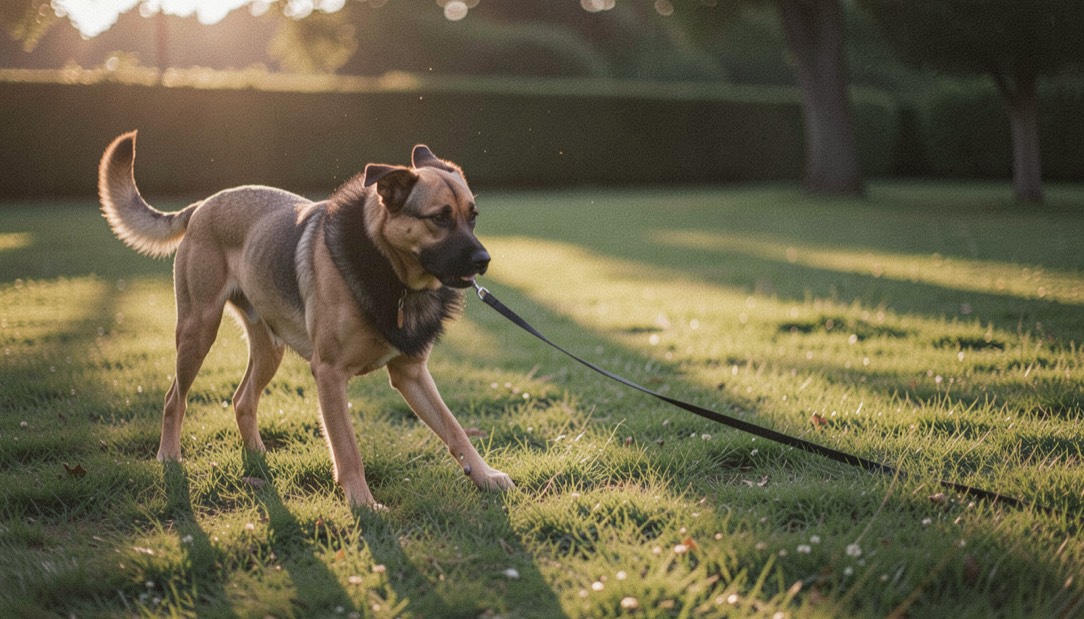
A Southern summer does not end a training program; it moves it. The session goes to first light or late evening, the surface gets checked before the dog walks on it, and the work that needs no yard moves indoors. The program keeps its length by changing its address, which is the whole trick.
The constraint is physiological, and it belongs to the dog, not to the handler's schedule. A dog cools itself mostly by panting, and panting works by evaporation: when the air is already soaked, the cooling system itself slows down. That is why the number on the porch tells less than the air feels: the heat index, heat and humidity together, is the honest reading of what the dog is carrying. What goes wrong when the reading is ignored has its own page, and it is the one page here written for the worst day: heatstroke first minutes.
Move the session, do not shrink it
The reflex that costs the most progress is cancellation. A dog that stops training for the length of a Southern summer loses months of momentum, and the behaviors built on rhythm are the first to erode. The alternative is scheduling: the same session, earlier and shorter and in shade, or moved under a roof with a fan moving the air. The dogs that come out of Southern summers with their training intact are the dogs whose handlers treated the calendar as the obstacle, not the dog.
The number on the porch and the air behind it
A morning at first light is worth two sessions at noon, and the reason is the pair of numbers that matter: the temperature the thermometer reads and the humidity the skin feels. High humidity is the hidden half of the heat index, and the dog pays it first because the dog cannot sweat a coat dry. The practical habit is simple and costs nothing: check the morning's heat index, not just the temperature, and let the session's address follow it. On the mornings the index is already high before breakfast, the session is indoors before it is canceled.
The surface decides before the dog does
The pavement, the deck and the boards hold yesterday's sun longer than the air holds it. The test is the back of a hand on the surface for a slow count: a surface the hand cannot hold is a surface the pads cannot walk. Grass and dirt run cooler than asphalt and concrete; shade moves the surface several degrees in the dog's favor; and the time of day changes the surface more than the air, because the asphalt is still giving back the noon sun at five in the evening. A dog that dances at the end of a leash on a sidewalk is sometimes reading the pavement, not the lesson.
The signals that end a session
The session ends on the dog's signals, and the signals are readable early. Panting that will not settle between reps; a tongue carried wide and long; the pace dropping, the responses slowing, the dog drifting toward shade or water; any wobbliness at all, which is the late signal and means the day is over and the watch begins. The skill is ending on the first signal, while the dog still has something in reserve, because a session ended one rep early leaves a dog that wants tomorrow's. A dog that has begun to overheat is a medical event, not a training event, and the response is on the emergency page.
The indoor half of the summer
The work that needs no yard is a long list. Short recalls down a hallway; the settling and the stay, rebuilt in the hardest room of the house; targeting and nose work around furniture; handling practice, the touching of paws and ears and mouth that a veterinary summer will ask for anyway; the names of toys, the trade games, the polite door manners that fall apart in every house by August. None of it replaces the field work, and all of it keeps the field work closer when the weather turns. Where the structured work leads, when the season opens, is the subject of dog event formats.
The windows, season by season
| Season | The window | The work that fits it |
|---|---|---|
| Early summer | Mornings still cool, evenings usable | The full program, sessions moved forward |
| Deep summer | First light, or indoors | Short sessions, shade work, the indoor list |
| Late summer | Mornings lengthening, surfaces still hot | The field work returning, on the hand tested surface |
| Fall | The long exhale, whole days open | Proofing, distance, the work the summer deferred |
| Winter | Cold rain more than cold air | Motivation work, precision, the indoor craft kept alive |
Before every session
The summer session checklist
Four checks, sixty seconds, before the leash comes out.
- The heat index for the hour, not just the temperature.
- The back of a hand on the surface, held for a slow count.
- Water for the dog within reach of where the session happens.
- The end signal chosen in advance: the first wide tongue ends the day.
Keeping this page honest
The physiology above is described in general terms, without thresholds or numbers to count against, because the dog in front of the handler is the instrument that decides. The first month of an adopted adult runs on the same windows, and it is mapped at an adopted adult dog; the noise and neighbor rules the early morning session crosses are at barking and neighbors.